
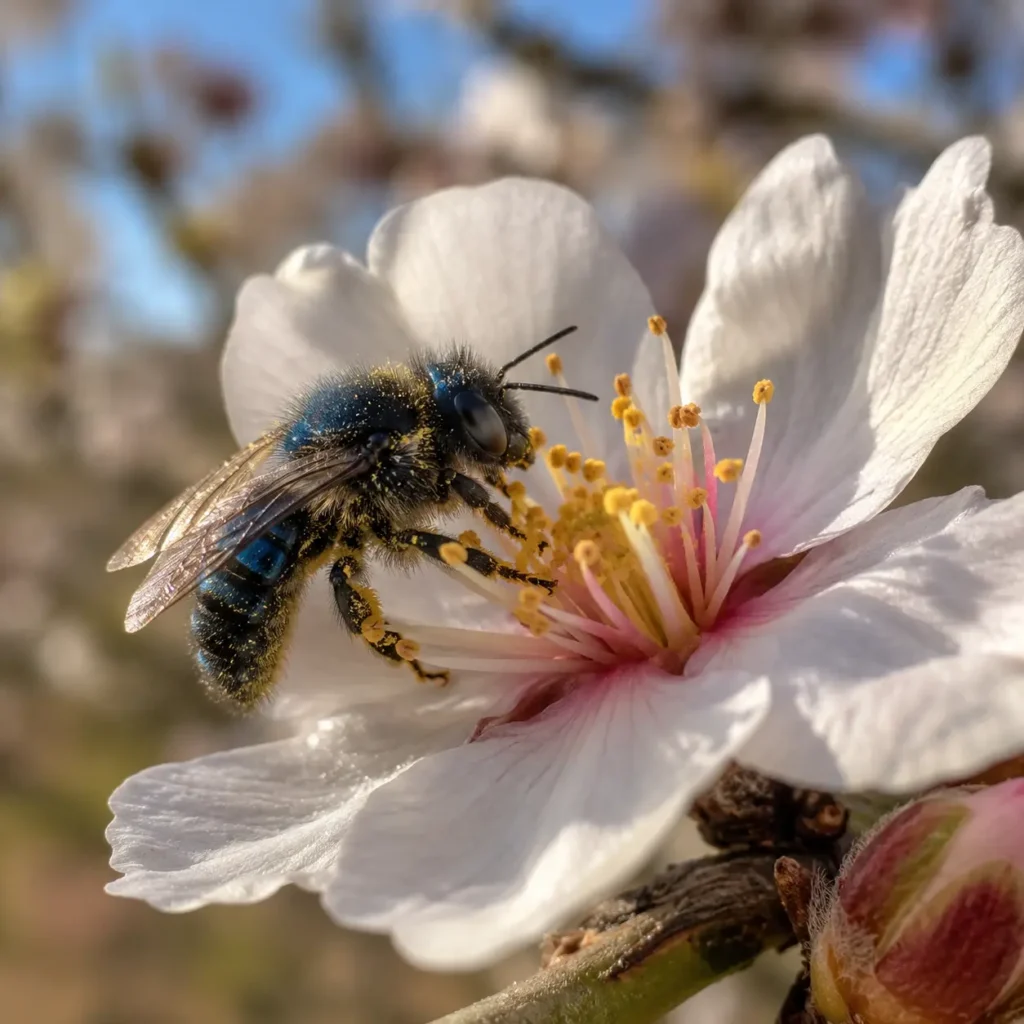
Introduction | Mason Bees in Agriculture – Small Pollinators with a Big Impact
Mason bees are gaining attention across commercial agriculture for a simple reason. They are highly effective pollinators that often outperform more familiar species like honey bees in certain crops. Despite this, mason bees remain underutilized and in many cases overlooked.
For commercial growers focused on yield, timing, and consistency, mason bees offer a compelling advantage. Their early seasonal activity aligns closely with flowering periods in crops such as almonds and apples and their pollination behavior increases the likelihood of a successful harvest. At the same time, their populations face increasing pressure from environmental stressors, insecticide exposure, and emerging biological threats like the Houdini fly.
Understanding mason bees is not just an ecological exercise. It is a practical step toward improving pollination outcomes and supporting long-term agricultural productivity.
What Are Mason Bees?
Mason bees are solitary pollinators. Unlike honey bees, they do not live in colonies or produce honey. Each female constructs her own nest, often using mud to seal individual chambers. This behavior gives mason bees their name.
They are known for their calm nature and are unlikely to sting. More importantly for commercial agriculture, mason bees emerge in early spring. This timing makes them well suited for pollinating crops that bloom before many other pollinators become active.
Two species are most commonly associated with agricultural use in the United States. The blue orchard bee, Osmia lignaria, is native and widely used in orchard systems. The hornfaced bee, Osmia cornifrons, was introduced and has also proven to be effective in commercial pollination.
History of Mason Bees in the United States
Mason bees have long existed in North America as part of native ecosystems. Their role in agriculture became more defined in the late 20th century.
In the 1970s, Osmia cornifrons was introduced to improve orchard pollination. This marked a shift toward exploring alternatives to honey bees, especially as concerns about honey bee health and availability began to grow.
Since then, mason bees have been adopted in specialty crops where precise and early pollination is essential. Their use continues to expand as growers look for reliable pollination strategies that do not rely solely on managed honey bee hives.
Why Mason Bees Matter in Commercial Agriculture
Pollination Efficiency
Mason bees are often described as efficient pollinators, and for good reason. A single mason bee can visit and pollinate significantly more flowers per day than a honey bee. This efficiency comes from their pollination style. Mason bees carry pollen loosely on their bodies rather than packing it into specialized structures. As they move between flowers, more pollen is transferred, increasing the chances of fertilization.
Mason bees are particularly effective in crops that require early pollination. These include crops like almonds, apples, cherries, and blueberries. Their activity during cooler temperatures also allows them to work when other pollinators are less active.
Operational Benefits for Commercial Growers
For commercial farmers, mason bees offer several practical advantages. They require less permanent infrastructure than maintaining honey bee colonies, and in many orchard systems, cocoons can be sourced through services that deliver them for seasonal release. This allows growers to use mason bees as supplemental pollinators as part of a broader pollination strategy.
However, not all species of mason bees are passive or self-sustaining in commercial settings. Their emergence does not naturally align with crop bloom, particularly in crops like almonds. To be effective, cocoons must be stored and managed under controlled conditions so that emergence is synchronized with flowering periods. After pollination, bees are often recaptured and removed for cleaning, sorting, and preparation for the next season.
Unlike wild pollinator populations, there are typically no resident mason bee populations in large-scale orchards. In practice, they are managed in a cycle that mirrors aspects of honey bee deployment, with added considerations around timing, handling, and recapture.
Even with these requirements, mason bees still provide value by helping diversify pollination strategies and reduce dependence on a single pollinator species. This added layer of resilience can be especially important in seasons where honey bee availability is limited or unpredictable.
How Mason Bees Compare to Honey Bees
Mason bees and honey bees serve different roles in agriculture. Mason bees operate within a smaller range, typically staying close to their nesting sites. This localized activity can lead to more consistent pollination within a given area. They are also more active in cooler and less favorable weather conditions. This extends the window for effective pollination.
Their lifecycle differs as well. Mason bees complete one generation per year, while honey bees maintain active colonies year-round. This makes mason bees easier to manage in some contexts but also more vulnerable to seasonal disruptions.
Environmental and Agricultural Threats to Mason Bees
Habitat Loss and Climate Variability
Like many pollinators, mason bees depend on stable environmental conditions. Loss of nesting habitats reduces their ability to reproduce. Changes in climate can disrupt the timing between bee emergence and crop bloom, limiting their effectiveness.
Pesticide Exposure
Mason bees are particularly sensitive to insecticides. Because they are solitary, there is no colony structure to buffer against exposure. A single application at the wrong time can impact a large portion of a local population.
Houdini Fly
One of the more specific threats to mason bees is the Houdini fly, Cacoxenus indagator. This parasitic insect targets mason bee nests. The fly lays its eggs in the same chambers where mason bees deposit pollen and eggs. When the larvae hatch, they consume the food supply intended for developing bees. This reduces survival rates and weakens populations over time. For growers relying on managed mason bees, the Houdini fly can quietly reduce pollination capacity without immediate detection.
Supporting Mason Bee Populations on Your Farm
Habitat Creation
Providing suitable nesting environments is one of the most effective ways to support mason bees. Nesting blocks and tubes allow females to lay eggs in protected spaces. Access to mud and water is also essential for nest construction.
Responsible Pesticide Practices
Timing is critical when applying insecticides. Applications should be avoided during active pollination periods whenever possible.
Using real-time pest monitoring data allows growers to move away from calendar-based spraying. Instead, treatments can be applied only when needed. This reduces unnecessary exposure for pollinators while maintaining effective pest control. Additionally, selecting products with lower toxicity to bees can also help protect local populations.
Managed Pollination Strategies
Mason bees can be used alongside other pollinators to create a more resilient system. Rotating nesting materials between seasons helps reduce the buildup of parasites like the Houdini fly. With proper management, mason bees can become a reliable component of a broader pollination strategy.
Frequently Asked Questions About Mason Bees
Are mason bees aggressive?
No. Mason bees are solitary and rarely sting.
How effective are mason bees at pollination?
They are highly efficient and can pollinate more flowers per bee than honey bees in certain crops.
Do mason bees produce honey?
No. They do not produce or store honey.
What crops benefit most from mason bees?
Tree fruits and early blooming crops such as almonds and apples benefit the most.
What is the Houdini fly and why is it a problem for mason bees?
It is a parasitic insect that lays eggs in mason bee nests, reducing reproduction and weakening populations.
Can mason bees be managed commercially?
Yes. They can be managed with proper nesting systems, monitoring, and seasonal care.
The Takeaway | Protecting a High-Value Pollinator
Mason bees play a valuable role in commercial agriculture. Their pollination efficiency, early seasonal activity, and ease of management make them a strong complement to traditional pollinators.
At the same time, they face increasing pressure from environmental changes, pesticide exposure, and biological threats like the Houdini fly. These risks are often difficult to detect until populations decline.
For growers, the path forward is clear. Supporting mason bees requires a combination of habitat management, targeted pest control, and better visibility into field conditions. Monitoring systems that provide real-time insights can help bridge the gap between protecting crops and preserving pollinators.
Mason bees may be small, but their impact on crop production is significant. Protecting them is not just about conservation. It is about strengthening the foundation of modern agriculture and ensuring consistent yields in an increasingly complex environment.