
Introduction | The Slime Trail Running Through Commercial Agriculture
Snails and slugs rarely get the same attention as fast-moving insects, orchard rodents, or disease outbreaks. They are slow, quiet, and often most active when farmers are not walking the field. Still, their impact can be far greater than their pace suggests.
Understanding snails and slugs in commercial agriculture is becoming increasingly important for growers managing fruit, nut, vegetable, nursery, and specialty crop systems where quality standards leave little room for hidden pest damage. These mollusks can feed on seedlings, leaves, bark, ripening fruit, and marketable crop surfaces. In many cases, the first warning sign is not the pest itself, but the silvery trail left behind after the damage has already begun.
For commercial growers, the issue is not just whether a plant survives. It is whether the crop reaches harvest cleanly, consistently, and at a quality level the market will accept.
What Are Snails and Slugs?
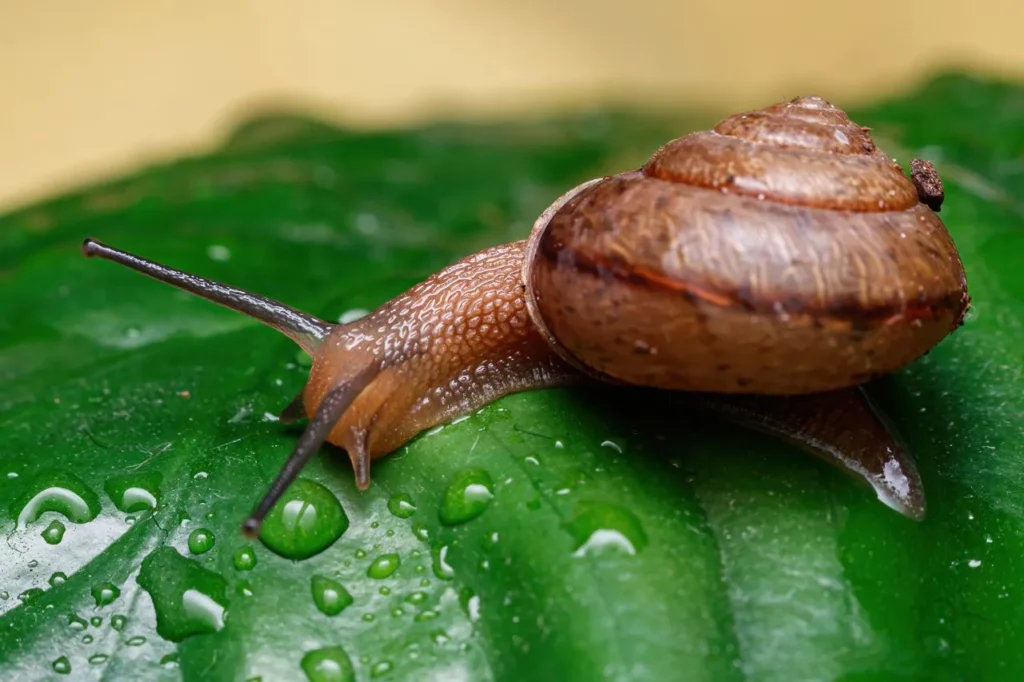
Snails and slugs are mollusks, not insects. The main difference is easy to spot: snails have shells, while slugs generally do not. Both rely on moisture and shelter, which is why their activity often increases at night, after rainfall, after irrigation, or during cool, cloudy conditions.
Their feeding pattern is different from many chewing insects. Snails and slugs use a rasping mouthpart to scrape plant tissue. That feeding can create irregular holes, shredded leaf edges, surface scars, smooth pits, and damaged growing points. Because those symptoms can resemble injury from earwigs, caterpillars, beetles, or other chewing pests, scouting often requires looking for mucus trails, protected hiding places, and fresh feeding damage. UC IPM notes that snail and slug damage can often be confirmed by looking for silvery mucus trails near the injury.
In commercial settings, species and risk vary by region and crop. Brown garden snails are known pests in California citrus and horticultural systems. Gray garden slugs and gray field slugs can affect strawberries, vegetables, field crops, and specialty production systems.
Why Snails and Slugs Matter to High-Value Specialty Crops
Snails and slugs are not the same type of pest as codling moth, navel orangeworm, oriental fruit moth, or other insect pests commonly discussed in orchard and specialty crop management. Still, they belong in the same broader conversation because commercial agriculture does not deal with pest pressure one species at a time.
A grower managing almonds, pistachios, walnuts, figs, apples, pears, stone fruit, citrus, strawberries, or vegetables is often dealing with overlapping pressures from insects, mollusks, rodents, irrigation patterns, weather, sanitation, and market requirements. One pest may affect yield volume. Another may affect crop appearance. Another may raise food safety concerns. The final result is often the same: reduced marketable yield.
In citrus, brown garden snails can feed on ripe and ripening fruit, young tree leaves, and young bark in nursery settings. In strawberries, slugs may feed directly on ripe berries, creating rough holes that make fruit difficult or impossible to sell. In tree fruit and orchard systems, dense groundcover, low-hanging branches, and moist microclimates can create protected spaces where snail and slug pressure builds quietly.
Leafy greens and vegetables carry an added concern. Because these crops are often harvested close to the ground and may be eaten raw, contamination from snails, slugs, slime, feces, or small fragments of mollusks can shift the issue from crop quality to food safety.
How Snails and Slugs Damage Crops Before Harvest
In commercial agriculture, the difference between a healthy crop and a profitable crop often comes down to marketability. Snails and slugs exploit that narrow space.
A young plant may survive early feeding, but long-term establishment can suffer if seedlings are clipped, growing points are damaged, or seeds are hollowed before emergence. Leaves may recover from light feeding, but repeated injury can reduce plant vigor and create uneven growth. Fruit may continue to develop after surface feeding, but the visible damage can make it unsuitable for fresh market channels.
This is where snails and slugs can be especially frustrating. Their impact is not always measured by total crop loss. Sometimes the larger issue is the percentage of the crop that no longer meets buyer expectations. A scarred strawberry, chewed citrus rind, contaminated leafy green, or damaged nursery plant may represent lost value even when the plant itself remains alive.
When and Where Snail and Slug Pressure Builds
Snail and slug pressure tends to build where moisture, food, and shelter overlap. Dense weeds, crop residue, boards, rocks, irrigation infrastructure, low-hanging branches, and thick groundcover can all create daytime refuge. At night, the pests move out to feed.
That makes management more complicated in systems where moisture is part of the production environment. Strawberry beds, leafy greens, vegetable rows, orchard floors, and nursery blocks can all create favorable conditions. Reduced tillage and moisture-retaining practices may support soil health, but they can also maintain the cool, damp surface conditions that slugs prefer.
The goal is not to remove every source of moisture or cover from a farm. That would be unrealistic and, in many systems, counterproductive. The goal is to understand where pest-friendly conditions are forming and whether those areas overlap with vulnerable crop stages.
Rat Lungworm | Why Snails and Slugs Are Also a Food Safety Conversation
Rat lungworm adds another layer to the discussion. According to the CDC, rat lungworm is caused by Angiostrongylus parasites and is spread between rats and mollusks such as snails and slugs. Rat lungworm disease is associated with Angiostrongylus parasites. In the case of Angiostrongylus cantonensis, rats are the primary host, while snails and slugs often serve as intermediate hosts. People are accidental hosts.
Human infection is generally tied to consuming infected snails or slugs, often accidentally. That can happen when small mollusks, or pieces of them, are present on raw produce. Contaminated hands during the preparation of infected snails or slugs can also create risk if the parasite is ingested.
This does not mean growers should panic every time they see a slug in a field. It does however mean snail and slug management connects to sanitation, worker training, harvest inspection, produce washing, rodent pressure, and regional awareness. In areas where rat lungworm is present or suspected, the conversation becomes larger than crop damage alone.
Symptoms of Angiostrongylus cantonensis infection can mimic bacterial meningitis and may include nausea, vomiting, neck stiffness, severe headache, and unusual sensations in the arms or legs. The risk is real enough that growers, produce handlers, and food safety teams should understand how snails, slugs, and rats fit into the same cycle.
Recent Developments | Rat Lungworm Reaches California
Rat lungworm has recently become a more relevant topic for West Coast agriculture. A 2026 report in the CDC’s Emerging Infectious Diseases journal documented Angiostrongylus cantonensis infections in a zoo-housed wallaby, free-ranging Virginia opossums, and roof rats in San Diego County. The report noted that these findings support the possibility that the parasite could now be considered endemic in that portion of Southern California.
For commercial agriculture, the takeaway is awareness rather than alarm. California is home to major specialty crop production, including many crops where quality, sanitation, and export confidence matter. If a pest issue can affect produce safety perception, harvest practices, or consumer trust, it deserves a place in the broader pest management conversation.
Managing Snails and Slugs in Commercial Agriculture
Snail and slug management works best as a layered effort. There is rarely a single tactic that solves the problem across an entire operation.
Habitat reduction is often the first step. Removing unnecessary debris, managing weeds, reducing protected hiding places, and improving airflow can make areas less favorable. In orchards, pruning low-hanging skirts and reducing access points to fruit can help limit movement into the canopy. Irrigation timing and placement also matter, especially where prolonged surface moisture creates feeding opportunities.
Monitoring should be consistent and practical. Early morning scouting, nighttime checks, refuge boards, inspection of field edges, and attention to slime trails can help growers identify pressure before damage becomes widespread. Where baits or other controls are used, they should be timed to pest activity and applied according to label requirements. This same mindset also applies to larger pest management challenges, including insecticide resistance in commercial agriculture, where delayed or incomplete pest data can make management decisions more difficult.
Biological control and emerging tools may also play a role in some systems, but they should be approached carefully. Pest management decisions need to account for the crop, region, non-target organisms, regulatory requirements, and the economics of the operation.
Why Monitoring Still Matters in a Multi-Pest Environment
FarmSense’s technology focuses on real-time insect pest monitoring, not snail or slug detection. Still, the broader principle applies across pest management: earlier visibility supports better decisions.
Insect traps, field scouting, slug boards, weather data, irrigation records, harvest observations, and sanitation notes all help reduce uncertainty. When growers have a clearer view of what is happening in the field, they can respond with precision instead of routine. This is especially important in systems like almonds, where timing, pest identification, and field-level data can influence treatment decisions.
That is the real connection between snails, slugs, insects, and modern commercial agriculture. Pest pressure is not isolated. A grower’s response should not be isolated either.
Frequently Asked Questions About Snails and Slugs in Commercial Agriculture
What crops are most affected by snails and slugs?
Snails and slugs can affect citrus, strawberries, leafy greens, vegetables, nursery crops, seedlings, and low-growing fruit. Risk is highest where moisture, shelter, and vulnerable crop tissue are present at the same time.
How can growers identify snail or slug damage?
Common signs include irregular holes, scraped leaf tissue, chewed fruit, smooth pits, and silvery slime trails. Because damage can resemble feeding from other pests, the slime trail is often an important clue.
Are snails and slugs insects?
No. Snails and slugs are mollusks. This matters because many insect-focused control tools are not designed to manage them.
Can snails and slugs contaminate produce?
Yes. They can contaminate produce through their presence, slime, feces, or fragments left on harvested crops. In areas where rat lungworm is present, they may also be part of a food safety discussion.
How does rat lungworm relate to agriculture?
Rat lungworm connects snail and slug pressure to produce handling, rodent management, worker hygiene, harvest inspection, and consumer confidence. It is a reminder that pest management and food safety often overlap.
The Takeaway | Following the Slime Trail Before It Reaches the Harvest
Snails and slugs may not arrive with the speed of an invasive insect or the visibility of a rodent problem, but they leave a trail, literally and figuratively. For commercial agriculture, that trail can run through damaged fruit, weakened seedlings, rejected produce, sanitation concerns, and emerging public health questions like rat lungworm.
The future of pest management will not be defined by reacting only to the most obvious threat in the field. It will be shaped by a grower’s ability to see the full system more clearly. From insects in the canopy to mollusks in the moist soil below, every signal matters. In modern commercial agriculture, even the smallest trail can point to a larger risk.